
"Our only senior engineer left three months ago, and nobody on the team can safely deploy." That's a line from a real job post we read on Upwork. Three months. For three months the business kept running on software nobody could touch.
It's a common story. The first weeks decide how expensive it gets, because the mistakes people make in a panic, such as letting a stranger push changes to a live system or agreeing to start over from scratch before anyone has read a line of the existing code, are the ones that cost the most to undo. Here's the order we'd do things in if it happened to a client of ours, with rough costs at our rate of $40 an hour.
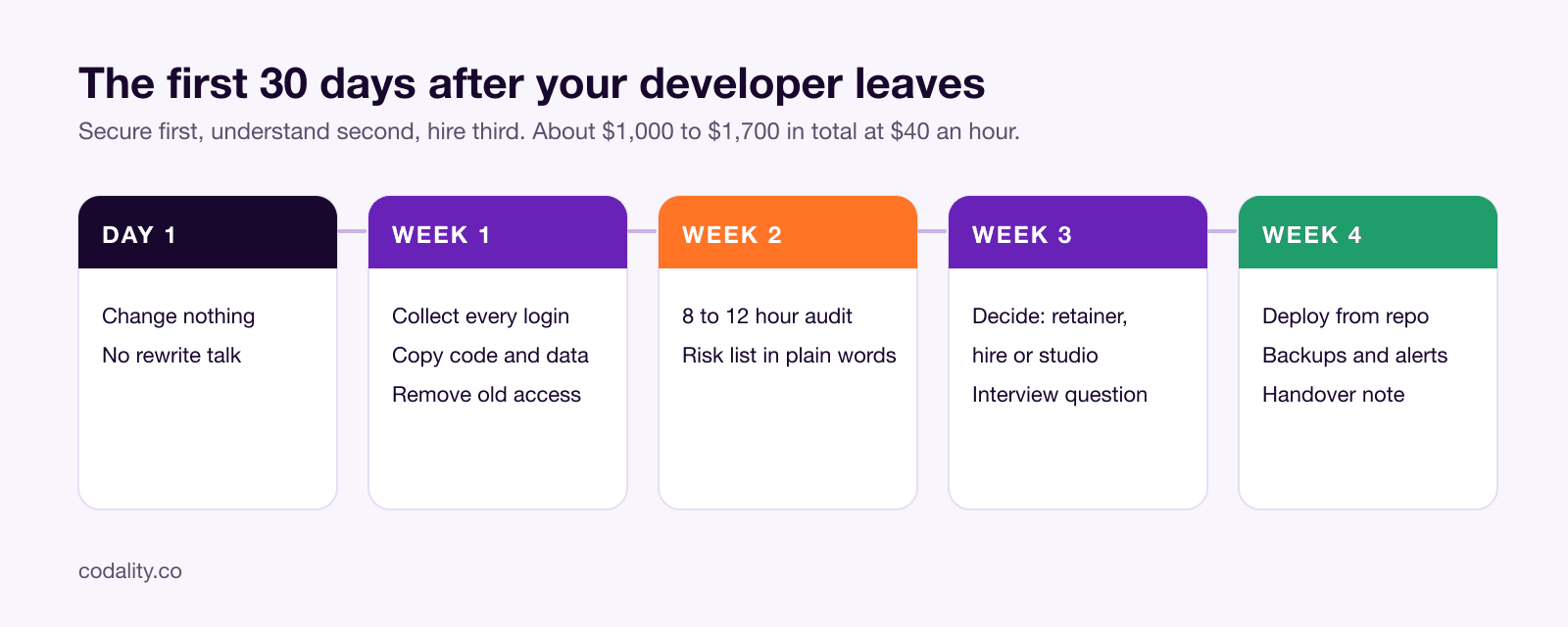
Day one: two rules
Don't change anything. The product works today. Leave it. Every "small fix" made without understanding the system is a chance to take it down, and nobody is around to bring it back.
Don't agree to a rewrite yet. The first developer you talk to may say the code is a mess and should be redone. Sometimes that's true. Often it's the easiest thing to say about someone else's work, and it turns a $2,000 problem into a $30,000 one. You'll know which it is after an audit, not before.
Week 1: get the keys and a copy
Before anyone looks at the code, make sure the business can't lose the product. Access first, code later.
Go through this list and write down, for each item, who has access and where the login lives:
- the domain registrar
- hosting and the server, or the cloud account
- the code repository, usually GitHub, GitLab or Bitbucket
- the database and its admin panel
- payments, usually Stripe or PayPal
- email sending, analytics, error tracking, any AI or maps service the app uses
- app store accounts, if there's a mobile app
If an account is registered to the developer's personal email, ask them to transfer it, politely and in writing. Most will. If they've gone quiet, the registrar and hosting company can usually move an account to the paying business with proof of payment, but it takes weeks. Start now.
Then take a copy of everything: the code, a database export, the files users uploaded. Put it somewhere two people can reach. This is a day of work for a developer, around $320, and it's the best money you'll spend this month.
Last, change the passwords and remove the old access. Not because the developer is a villain, but because an account nobody watches is how breaches happen.
Week 2: an audit, not a rebuild
Now someone needs to read the code and tell you what you've got. Not fix it. Not improve it. Read it, run it, and report back.
A good audit takes 8 to 12 hours and gives you a one-page answer to five questions:
- Can the app be deployed from the code in the repository, or does it only exist on the server?
- Where are the secret keys and passwords, and are any of them in the code?
- What's out of date, and does any of it carry a known security problem?
- What's documented, what isn't, and what would a new developer need a week to work out?
- What breaks first if nobody touches this for six months?
Ask for the answers in plain language, as a list sorted by risk, not a 40-page report nobody will open. If the auditor can't explain a problem without jargon, they don't understand it well enough yet.