
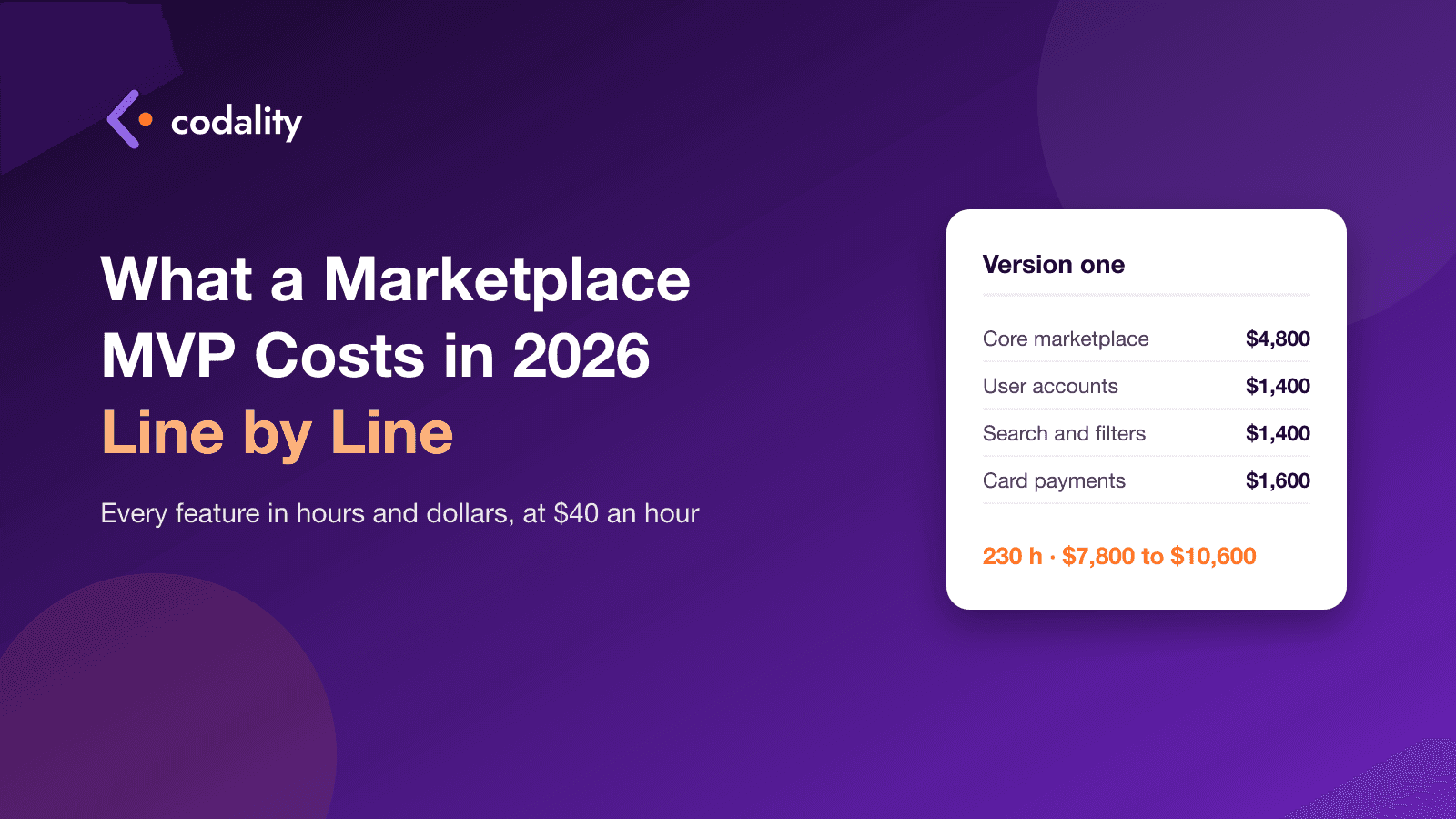
How Much Does a Marketplace MVP Cost in 2026? A Line-by-Line Breakdown

Agencies quote $40,000 and up. Founders on Upwork offer $5,000. Both are talking about a marketplace. Here is what each feature costs in hours and dollars, and where the gap comes from.

· 5 min read
How Much Does a Marketplace MVP Cost in 2026? A Line-by-Line Breakdown

Ask three agencies what a marketplace MVP costs and you'll get $35,000, $60,000 and "it depends". Then open Upwork, where founders post the same idea with $5,000 attached and 300 developers apply anyway.

Both sides are describing a real product. The difference is what's inside it. So instead of one number, here's the list: what each part of a marketplace takes to build, in hours and in dollars, at the rate we charge, $40 an hour. You can argue with any line. That's the point of showing them.

What a marketplace has to do on day one

A two-sided marketplace has three jobs. Let people list something, let other people find it, and let money change hands. Everything else, from reviews to chat to a seller dashboard, is a layer on top.

That first layer is where the first 20 customers come from, and it's smaller than most briefs we read. One brief wanted in-app messaging, reviews, seller payouts, a referral program and an admin panel in version one. The founder had never sold a single listing yet.

The core, line by line
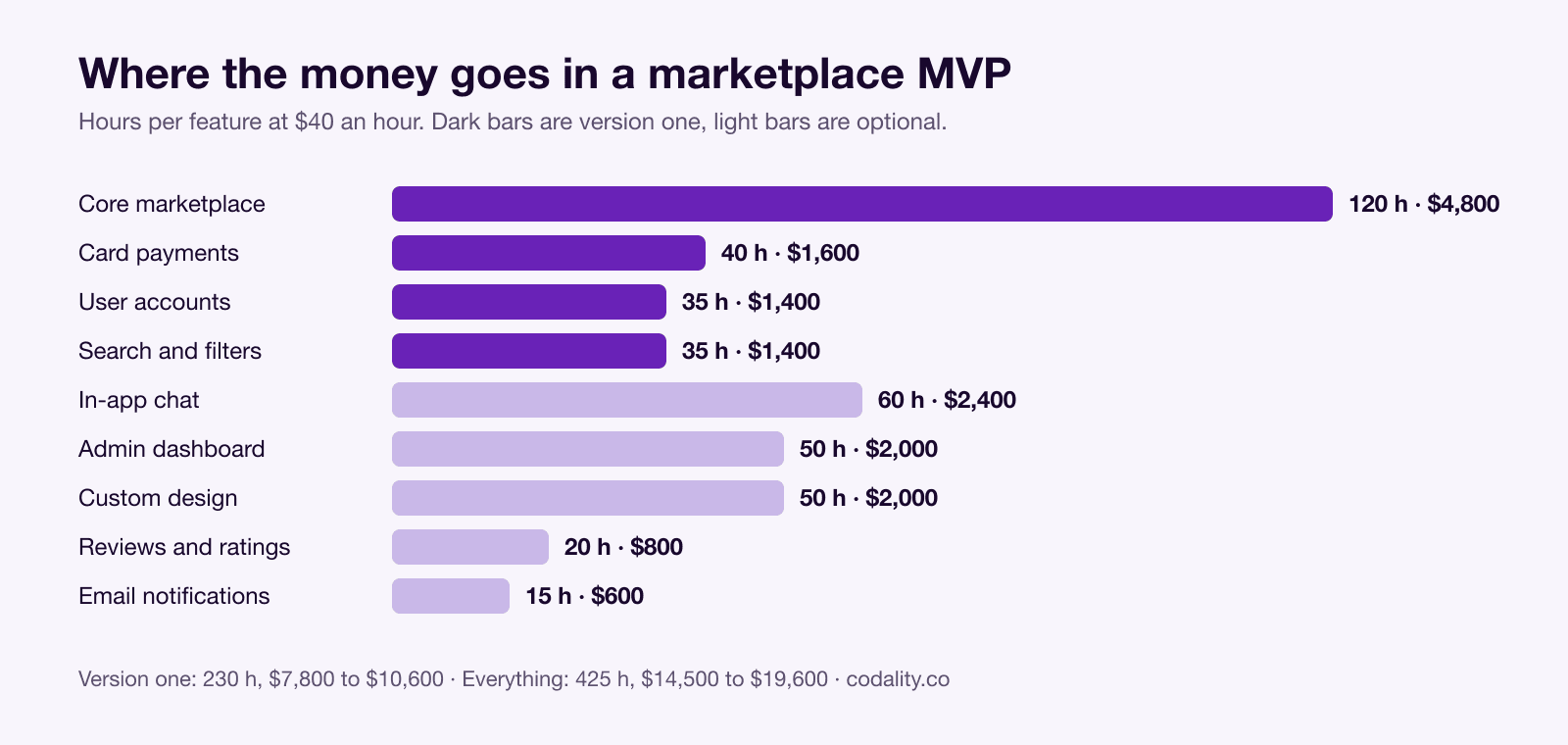
Hours and cost of a marketplace MVP, feature by feature

These are the numbers behind our estimate calculator. They assume a web app that works on phones, built on a template design, by a small team that has done this before.

PartWhat's in itHoursAt $40/h
Core marketplaceListings with photos and prices, seller and buyer sides, a basic profile, the pages that hold it together120$4,800
User accountsSign-up, login, password reset, two roles35$1,400
Search and filtersKeyword search, category and price filters, sorting35$1,400
Card paymentsCheckout through Stripe, payment confirmation, order record40$1,600

That's 230 hours. With a 15% margin either way, because estimates are estimates, the range is $7,800 to $10,600, in 6 to 8 weeks.

This version can take a listing from a seller, show it to a buyer and collect a payment. It can't do much else, and that's fine for finding out whether anyone wants it.

What pushes the price up

AdditionHoursAt $40/hWorth it in version one?
Email notifications15$600Yes. New order, new message, cheap and useful
Reviews and ratings20$800Usually. Trust sells on a marketplace
Admin dashboard50$2,000Later. A spreadsheet and database access cover the first months
In-app chat60$2,400Later. An email thread between buyer and seller works
Custom design50$2,000Only if the look is part of the pitch

Add all of it and you're at 425 hours, $14,500 to $19,600, 11 to 13 weeks. Still a long way from $60,000, and still a complete product.

Two things aren't on the table because they're multipliers, not features. A rush deadline adds 25% to the price and cuts the timeline by about a quarter. And seller payouts, where the platform keeps a commission and sends the rest to the seller, are a separate piece of work on top of plain card payments. It's a common second step once sellers are real.

Why agencies quote $40,000 and up

Published guides for 2026 put a two-sided marketplace MVP anywhere from $12,000 to $50,000 to $50,000 to $120,000 and more, and one agency's own planning figure is $50,000 to $150,000 over 4 to 7 months. Those numbers aren't made up. They come from a different set of assumptions:

  • Hourly rate. A US or Western European agency bills $100 to $200 an hour. The same 230 hours cost $23,000 to $46,000 before anything is added.
  • Team size. A project manager, a designer, two developers and a QA engineer, each billing time, each needing meetings with the others.
  • Scope by default. Chat, reviews, admin, payouts and a native app often go in the first quote because nobody asked what could wait.
  • Discovery phases. Two to four weeks of workshops before any code. Useful for a large product, oversized for a first version.

None of this makes the bigger quote wrong. It makes it a different product, built a different way. The question to ask is which parts of it you need before your first customer.

What the price doesn't include

The build is the biggest cost, not the only one. Budget for these separately:

  • Payment fees. Stripe takes about 2.9% plus 30 cents per card payment, and more for marketplaces that pay sellers out.
  • Hosting and services. $20 to $100 a month for hosting, a database, email sending and a domain while you're small.
  • Your time. Someone has to find the first sellers, approve listings and answer support. In version one, that's you.
  • Changes after launch. Real users will ask for things you didn't plan. Keep 20% of the build budget for the month after launch.

How to keep it near the bottom of the range

  1. Write down the one thing a buyer must be able to do. Book a cleaner. Buy a used bike. Everything that doesn't serve that goes on the "later" list.
  2. Use a template design. Fifty hours is a lot of money to spend on being different before anyone has seen the product.
  3. Run the back office by hand. Approve sellers yourself. Handle disputes over email. Build the admin panel when you're tired of it.
  4. Fix the budget, flex the scope. Tell the developer the number. A good one will tell you what fits inside it, and what to drop.

A number to start from

For most first marketplaces, the answer is between $8,000 and $20,000, and the lower end is a real product, not a demo. If you want the figure for your own feature list, pick the parts above in the calculator and you'll get a range in a minute.

And if the range looks wrong for what you have in mind, send us the list. We'll tell you what we'd build first, what we'd leave out, and what it would cost.

  • #marketplace
  • #mvp
  • #pricing
  • #startups
  • #cost estimate
Planning a product?

See what your first version would cost

Pick the features you need and get a price range and timeline in under a minute. No call, no sign-up.

Open the MVP calculator